
Glissando in Edge
Below you see a videoclip of Edge. The video was taken using a flexible endoscope inserted via the nose. Stroboscopic light is used so the vibration of the vocal folds can be seen in slow motion. The flashing of the stroboscopic light [...]
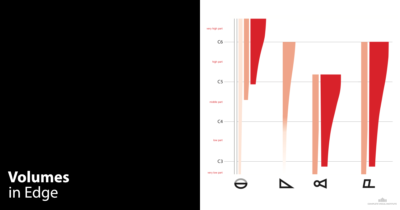
Volumes in Edge
Edge is a mode with the possibility of powerful volume, extending from medium loud (‘mf’ or ‘mezzo forte’) to very loud (‘ff’ or ‘fortissimo’). We divide the volumes in Edge into loud and medium. In [...]
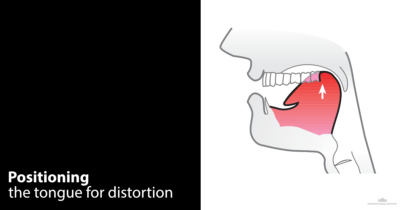
Distortion: positioning the tongue
When distorting, it is a trick to twang the epiglottic funnel a lot, which contributes to making the sound colour light and sharp. It may feel as if the back of the tongue is positioned [...]
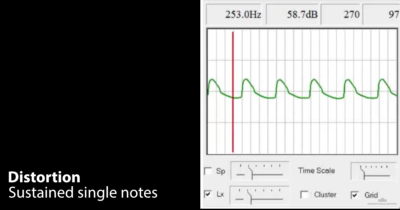
Distortion – sustained single notes
This video is a male singing on a sustained single note (C#4) on the vowel EE (as in ‘see’) in Neutral with air and then adding in distortion – and Neutral without air and then [...]
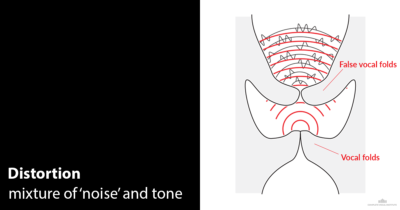
Distortion
Distortion is a ‘noise’, an effect that can contain a range of emotions from aggression to devotion. The effect is often used in connection with a note. The more you distort the sound, the more [...]

Support values
Higher notes require higher support energy. A higher volume also requires a higher support value. The support values for pitch and volume must be multiplied. If a singer has to sing an ascending scale at [...]
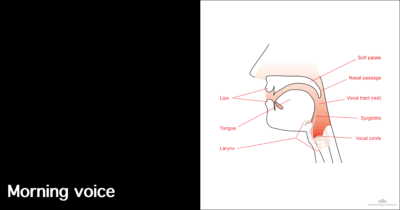
Constrictions
The ‘constrictor muscles’ that shape the vocal tract are very useful and also protect the vocal folds if a singer is exposed to great strain. The throat constricts if, for example, we lift something heavy [...]
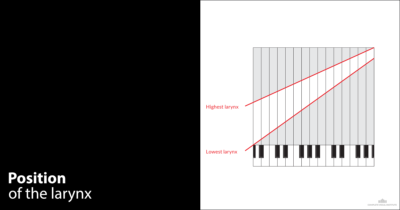
Position of the larynx
The position of the larynx is fundamental to the pitch. It is raised on high notes and lowered on low notes. The larynx should be positioned within an exact area in order to permit a [...]
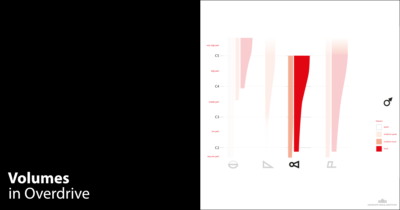
Volumes in Overdrive
The volume can be varied more easily in the lower part of the voice than in the higher part, as you can usually sing Overdrive more quietly in the lower part. In the beginning the [...]

The Epiglottic Funnel
Above the vocal cords are two quadrangular membranes. Together with the epiglottis at the front and the arytenoid cartilages at the back, they form a funnel, like a horn. The sides of this funnel are [...]

The tensions of language
Most singers have individual tensions, but they also have language tensions that are inherent to their spoken language. Every language has characteristic tensions and most singers unconsciously work these into their voice through many years [...]

Distortion & Rattle (High-speed)
Here you see a highspeed videoclip of a male singer singing with distortion in Overdrive. The singers starts in Overdrive and then add and remove the distortion and rattle. Notice the progressive narrowing of the [...]