
Today we are proud to announce that the first peer-reviewed paper on Complete Vocal Technique;
‘Overdrive and Edge as refiners of belting’
has been published in Journal of Voice! This is the first time Complete Vocal Technique is published in such a high-ranking scientific journal.
This is a tremendous acknowledgement from the scientific world, and we could not be happier!
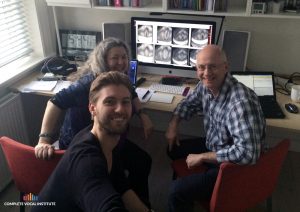
Cathrine Sadolin, Julian McGlashan and Mathias Aaen
Read the abstract to our first peer reviewed paper:
Objectives
We aimed to study the categorizations “Overdrive” and “Edge” from the pedagogical method Complete Vocal Technique as refiners of the often ill-defined concept of “belting” by means of audio perception, laryngostroboscopic imaging, acoustics, long-term average spectrum (LTAS), and electroglottography (EGG).
Study Design
This is a case-control study.
Methods
Twenty singers were recorded singing sustained vowels in a “belting” quality refined by audio perception as “Overdrive” and “Edge.” Two studies were performed: (1) a laryngostroboscopic examination using a videonasoendoscopic camera system (Olympus) and the Laryngostrobe program (Laryngograph); (2) a simultaneous recording of the EGG and acoustic signals using Speech Studio (Laryngograph). The images were analyzed based on consensus agreement. Statistical analysis of the acoustic, LTAS, and EGG parameters was undertaken using the Student paired t test.
Results
The two modes of singing determined by audio perception have visibly different laryngeal gestures: Edge has a more constricted setting than that of Overdrive, where the ventricular folds seem to cover more of the vocal folds, the aryepiglottic folds show a sharper edge in Edge, and the cuneiform cartilages are rolled in anteromedially. LTAS analysis shows a statistical difference, particularly after the ninth harmonic, with a coinciding first formant. The combined group showed statistical differences in shimmer, harmonics-to-noise ratio, normalized noise energy, and mean sound pressure level (P ≤ 0.05).
Conclusion
“Belting” sounds can be categorized using audio perception into two modes of singing: “Overdrive” and “Edge.” This study demonstrates consistent visibly different laryngeal gestures between these modes and with some correspondingly significant differences in LTAS, EGG, and acoustic measures.